Tuesday, December 12, 2006

Martha Schwartz interview

I just ran across this interview in Metropolismag.com. I was hoping to read a good in-depth, insightful interview. Let's just say I was disappointed. it comes across a one of those 20 pop questions type of interviews. Not quite what's your favorite color, instead we get . . . bookmarks? Bookmarks? Martha doesn't have any by the way.

Martha has continually pushed the envelope and has marketed her brand well. Her work gets lots of press, her people submit for awards (which they win), and the critics are severe. Sounds like someone at the top.


The infamous HUD Plaza.

I was hoping for some insight into her design process, and how she reads sites. Interprets the area she is going to work in. The best we get is her insistence on physically seeing the site and this tid-bit:

Most useful tool: My equal-space divider. You quickly divide things—as opposed to measuring them out—which is a godsend: I work fast and I’m bad at math.

Still if you are not familiar with her work take a look at the article, and then go to the firm's website, one of those fancy flash pages. Here you will get a much better understanding of her work, and a better understanding of the publicity machine, look at the amount of print, not including all the critics columns


Residence in SW, New Mexico, I believe.

For more info on Martha here is the Wiki entry for her. I was speaking earlier about how she has been lambasted by some . . . here you go.

To counter that Martha has won the Cooper-Hewitt design award, 2006 in Landscape Design (scroll down). The award was for her design of the Grand Canal Square in Dublin, Ireland, for a really great breakdown of that project I found this, and this from Ireland.

Martha is more of the artist side than the horticulture side of the picture and this mindset has put her on the opposite side of the fence with a lot of folks in the landscape design world. There is usually a lot of stuff going on in her projects, some would consider them very busy or not very people-friendly. You could even say they are better to look at and admire from a distance, than to actually participate in.

Her designs are not for everyone, but I admire her ability to push the envelope and take a chance in her public projects. Even if some projects weren't perfect who can say that all of their's were. I sure can't, can you? can anyone?

The important thing is to dream, to think big, to continue to reach out to be the best you can, the most expressive. The most creative. Keep going Martha.

powered by performancing firefox

Monday, December 11, 2006

Trees for the Future

Local children working to make their village a better place to live:

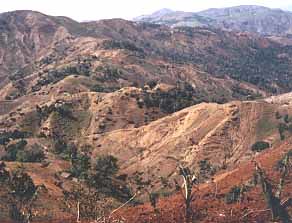
A denuded hillside in Central America:


If you have any interest working/supporting an organization the does reforestation work let me suggest Trees for the Future. I met Dave Deppner several years ago and immediately liked the man. he is honest, sincere, and dedicated, very dedicated. Dave is a strong believer in sustainable agroforestry, from the website:

Tree Planting: We help people plant multi-purpose, fast-growing, ecologically appropriate tree species. By choosing species tailored to the needs of the communities we serve, we create agroforestry systems that rebuild worn soils, reduce erosion, replenish groundwater aquifers and create microclimate conditions that encourage the return of indigenous species.

Agroforestry Training: We have developed a long-distance agroforestry training program that is being used to train community leaders worldwide in sustainable agroforestry practices. The curriculum covers agroforestry techniques, appropriate species, nursery management, livestock management, pest control, and more. Successful completion of an exam is required to graduate. To learn more, click here.

The "Forest Garden": The forest garden is a multi-layered agroforestry system that strives to realize the diversity and productivity of a natural forest with species of plants and animals that are useful to humans. In many cases, we see spectacular harvests from this combination of trees and cash crops. Integrating more crops on one piece of land yields greater total production, reduced incidence of insects and other pests, increased quality of food produced, and lowered damage from storms and soil erosion.

More stripped rainforest:


What's unique about Dave and Trees for the Future is how they spend the money. Dave goes right to the villages and the local leaders. His is truly work at the grass roots level. To educate, train, motivate the locals to become stewards of their land to begin the recovery in the area surrounding their local villages.

Too often the money starts at the top and works its way down through the levels, and in these 3rd World countries there are a lot of levels and a lot of interests, if you know what I mean. Dave has always believed it is better to go right to the people whose lives and villages are at stake.

Leucaena tree project. Leucaena benefits. The Moringa oleifera tree "Horse Radish tree". These are 2 of the several trees used to reclaim the land. Erosion control, feed for the live stock, compost materials, fuel and building materials are factors when considering which trees to use.

The other challenge is getting local farmers to try something different. The peer pressure is great amongst most locals to not change, to do it the same way its always been done. To start anew, to become terrace farmers, and sustainable aware is tough. But Dave and his volunteers keep plugging along, trying to change one farmer on village at a time.

If you're looking for a cause/group to donate time or money, let me again suggest Trees for the Future.

powered by performancing firefox
Saturday, December 09, 2006

Sandstone thoughts, continued

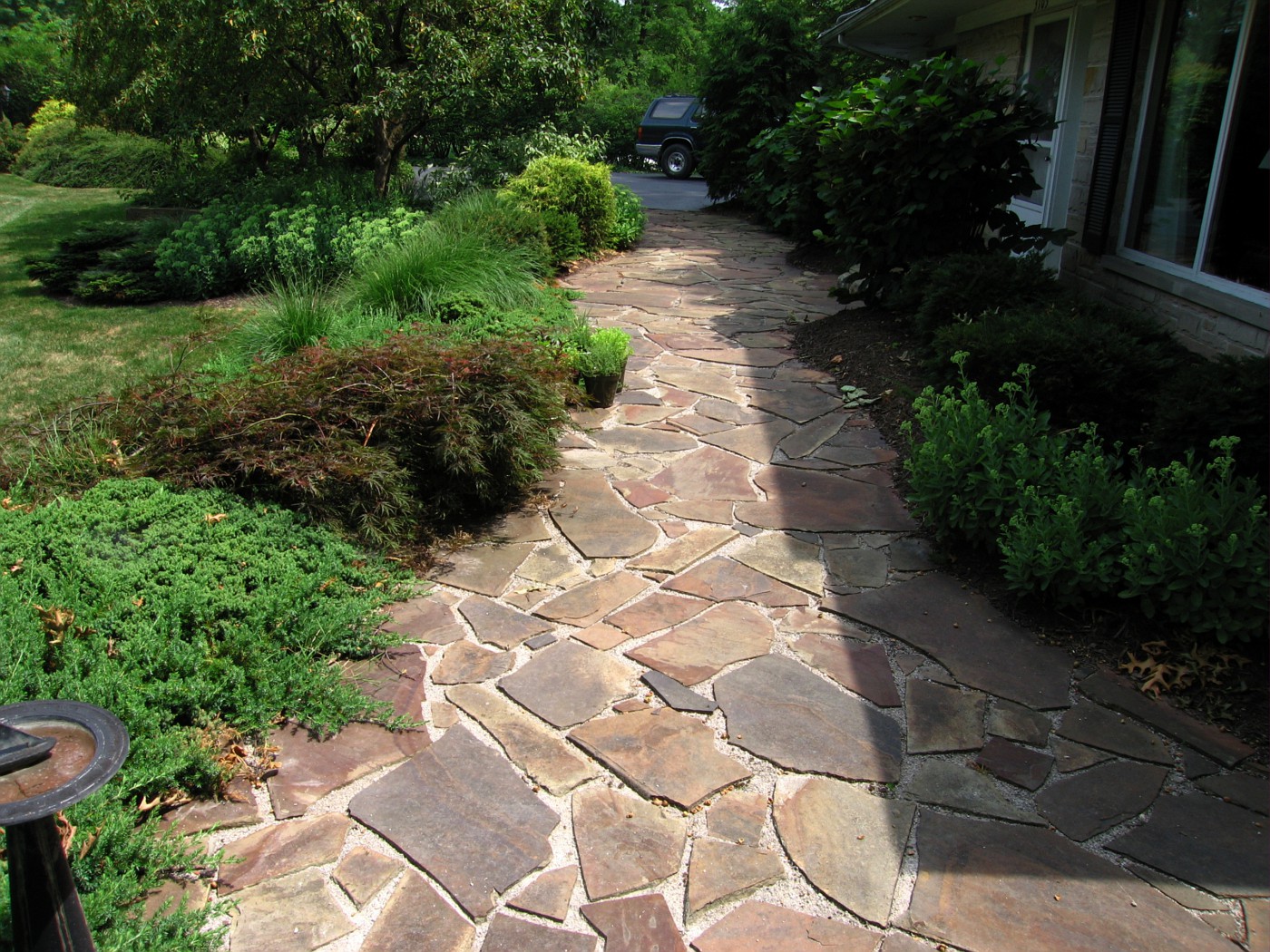
The steps from a wider angle:

On 12/7 I posted a close-up of the stone steps, showing some of the detail. I was after a look of strong yet informal steps that led out on to the lawn.

These steps are the only way to get from the parking court and upper terrace to that front lawn. The large barnstone on the left was needed to hold up the planting bed. This bed was designed in to screen the view of the cars from the street. and create a buffer of green between the view and the asphalt.

The bed swirls on the right before working back into another small wall that took advantage of stone found on the property. This wall was built to hold up the planting bed and upper terrace walkway and patio.


The view from here show the upper terrace. This is a flat stone called Maryland chocolate set on a bed of limestone dust and screenings. The steps are at the far end of this patio between the Crabapple trees. If I remember correctly these are "Sugar Tyme' Crabs.

I would like to point out these pictures were taking last summer, the Summer of 2006, and this job was installed in the Spring of 2000. The patio has held up quite well, and most of the plants are still in the same place we planted them 16 years ago.

I had an opportunity to chat with one of the homeowners. She had pulled in when I was shooting these pictures. We talked about several things and she mentioned how happy they had been with everything all these years. I had to tell her they had done a great job with the upkeep and that everything still looked great.


This view shows a better look at the short wall that holds up the small bed and terrace. The beds; after 16 years, look fairly tidy.

Thursday, December 07, 2006

Sandstone thoughts


"Without discipline, there's no life at all." -Katherine Hepburn

powered by performancing firefox

Wednesday, December 06, 2006

The Vermont Gardener, a man who loves stone.

How could you not like an post about the use and love of stone. George has written a nice piece about stone, moving stone, and how stone works in his garden.

What I especially liked was his mention of The Forgotten Art of Building a Stone Wall by Curtis Fields. If my memory serves correct this was the 1st book on stone in my library. George is right, it is a small, clean simple book, but if you love stone, and want to build walls it is an indispensable tool in you stone building toolbox.

Thanks George and keeping moving those stones. Nice use of standing stones, look to the last photo in the post.

powered by performancing firefox

BYU Landscape Management

Brigham Young University has a page that touts their degree in Landscape Management. A snippet from their web page:

This can be found in a life-long and rewarding career as a landscapemanagement major within the college of Biology and Agricul-ture.

Landscape management, a relatively new program at Brigham Young University, is highly respected among its professional commu-nity andoften turns into an equally profitable career.

I've seen degrees in Landscape Architecture, Landscape Design, Horticulture, Landscape Technician(2 yr). This is the 1st I've seen in Landscape Management. A degree in this field makes sense as Landscape Companies grow their is a need to have solid designers, foremen, and supervisors on staff.

Here's to hoping that BYU remembers that landscaping begins with the use of a shovel, and that hard physical work in the field is the beginning of success

powered by performancing firefox
Monday, December 04, 2006

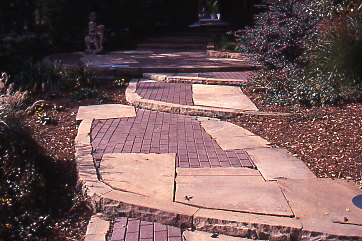
Stone and Paver Walkway, Answers to Questions

This continues the story from Sundays post on The Appreciation of Stone. I've been asked a few questions and will attempt to answer them here:

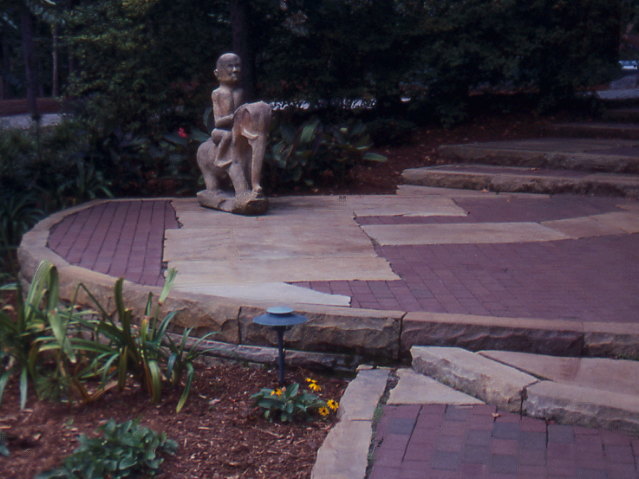
  • The stone and brick are not the same depth. The stone was placed 1st and the pavers were poured around the stone.
  • The stone is a waste product from Briar Hill Quarries near Glenmount, Ohio. They use to refer to this product as: 3" offset. Briar Hill has changed the way they cut blocks of stone and they don't have much of this product on hand now.
  • The wall stone is also a Briar Hill product. They sell several different sizes of this wall stone. It can be used as a freestanding wall, or a retention wall. Seen here it makes beautiful risers for outdoor steps.
  • This was in South Carolina about 30 miles above Columbia. Yes, that means we shipped a semi-load of stone down to install the walkway.
  • This photo, and Sundays were taken about 2 yrs after the job was installed.
  • The slab-bench photo was taken right at the end of initial installation.
  • Yep, the pavers are brand new, and very architectural in style (clean edges and lines). Complete opposite of the rough and tumble sandstone. I was looking to mix opposites together to create strong visual interest.
  • The entire length was over 120 feet and did vary width wise 5 to 8 feet with that landing.
  • The landing was built to display art and as a visual resting spot, It was not built to hold furniture, or to become a patio. After two years it was still that way.
  • The original request was to create a visual entertaining walkway from the parking court at the front of the house to the pool house on the other side of the service drive. You can see the opening to the pool area at the end of the walkway in that small patch of light in the dark area (top center).
  • I'm still looking for the drawings for this project. I have the original concept drawings, and they are buried away somewhere.
I think that's everything that was asked of me. I enjoyed the project very much the client was actually very easy to work for, and they enjoyed the final product. Most of the plantings were installed at the initial phase, we went for perennials and a few shrubs that would adapt to beds without irrigation.

The only questions I don't want to get in here are the cost of the install. I hope the questioner will understand. Yes I do charge an hourly rate but when working away from the home base area I have daily and weekly rates along with expenses.

Thanks for all the interest, and questions. I'll keep looking for the drawings . . .

Sunday, December 03, 2006

An Appreciation of Stone 19

Friday, December 01, 2006

Yes, it's about Landscape Design . . . but . . .

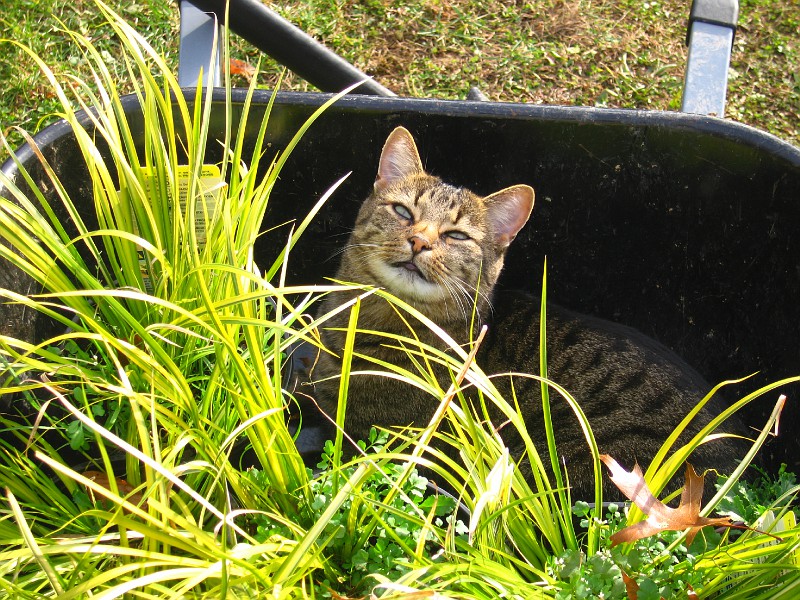
Spaz in the wheelbarrow
We have a low spot in a bed where the water will lay for; up to, 24 hours. The soil is clay, and it's a nasty area. I was able to do some mounding in the middle and back part of the bed to raise those areas, however we know beds have to slope down to their edge. What to do, what to do . . .

Well the entire area is low, water collects, I am not going to raise the entire area because a stone walkway is going through next year, and it needs to be at that height to set up a series of steps out of the low lying area. So it's going to stay low.

This means I have to look for plants that will endure this type of culture/micro-climate. I am one of those who would rather find a plant that lives in a certain type of micro-climate than change the area entirely.

What I have learned over my many years is one change leads to another, to another, to another usually affecting another part of the garden in a very negative way. Specifically moving water, drain water, run-off, etc. Water is at the top of the list.

I have also learned there are plants to adapt to almost every climatic, cultural situation. You just have to learn what works where . . .. a good reason to hire the Professional Designer (shameless plug).

But I digress, the plant in the wheelbarrow, along with Spaz, is Acorus gramineus commonly called sweet flag. Acorus is a short grass and does very well in standing water, temporary flooding, and straight clay soils. I have used Acorus in these conditions from zone 4 down to zone 9 with good results.

Spaz had decided to help us out when he jumped in the wheelbarrow and decided to nap instead-typical cat. Anyone on this cold blustery day I thought I would share this photo and talk about plants and drainage.

Sort of kill two birds with one stone. Uh; maybe that's a bad analogy when cats are involved in the story.

Wednesday, November 29, 2006

Whats in a Word?

On 11/21/06 I posted a short blurb about books for the laymen in reference to a short list of books for (what I consider) folks who want to design/garden their property. So I was using laymen as a term for someone who is interested in horticulture/gardening but in no way, shape or form receives money for their interest.

On Nov. 27th over at a blog called A Lake County Point of View, the County Clerk was kind enough to refer to another post of mine 27 Books every Landscape Designer Should Read. In this post he also mentioned the 11/21 post; inside that post was a comment about my referring to laymen, and referencing the word layman was a little pretentious-on my part.

This starts a little back and forth, and a question from me about what term should I have used instead of laymen? So today the County clerk post a long discussion (quite interesting) starting with an apology to me-which I didn't think was necessary, but it is accepted.

Now the good stuff, this is a great post on the English language and the importance of words and how they are used, or should be used. It is a fantastic explanation of connotation vs. denotation with a little classical music thrown in.

My point in bringing all this to the forefront? What have I learned? Well one thing I have learned from this Blog was that I needed to craft my wording so that others would understand my way of speaking/talking/writing. I had previously been published over 35 times (mostly trade journals) but always had the other set of eyes look at my writing-the editor. I was lazy, editors made it too easy for me. It was, "just give me the how-to's of the installation, I'll clean it up for publication".

Well that's not the case here with this Blog . . it's me. What I write here is what makes it out to cyberspace and the public world. I gotta tell you, I like it. I like the challenge - a lot. So when I am called out on something, something like this (the use of word laymen), I really don't mind.

I have gotten lazy with some words, for me laymen/layman had become the great catch-all. Laymen was easy. So I ask you this . . . what is a better way to describe those that love to garden? those that like to be out in their private spaces, to dig in the dirt, to nurture those plants? With no thought of monetary reward. To separate Professional from the strict amateur.

By the way A Lake County Point of View is a terrific read all the time, so many interest, so much thought. Heck, just go back and read last weeks entries about Walnut, you'll understand. Great stuff.

*Small confession: my wife has been known to log on here and do a little editing, she is terrific at catching all the typo's and stuff that I am good at missing. Many thanks Mrs. A.

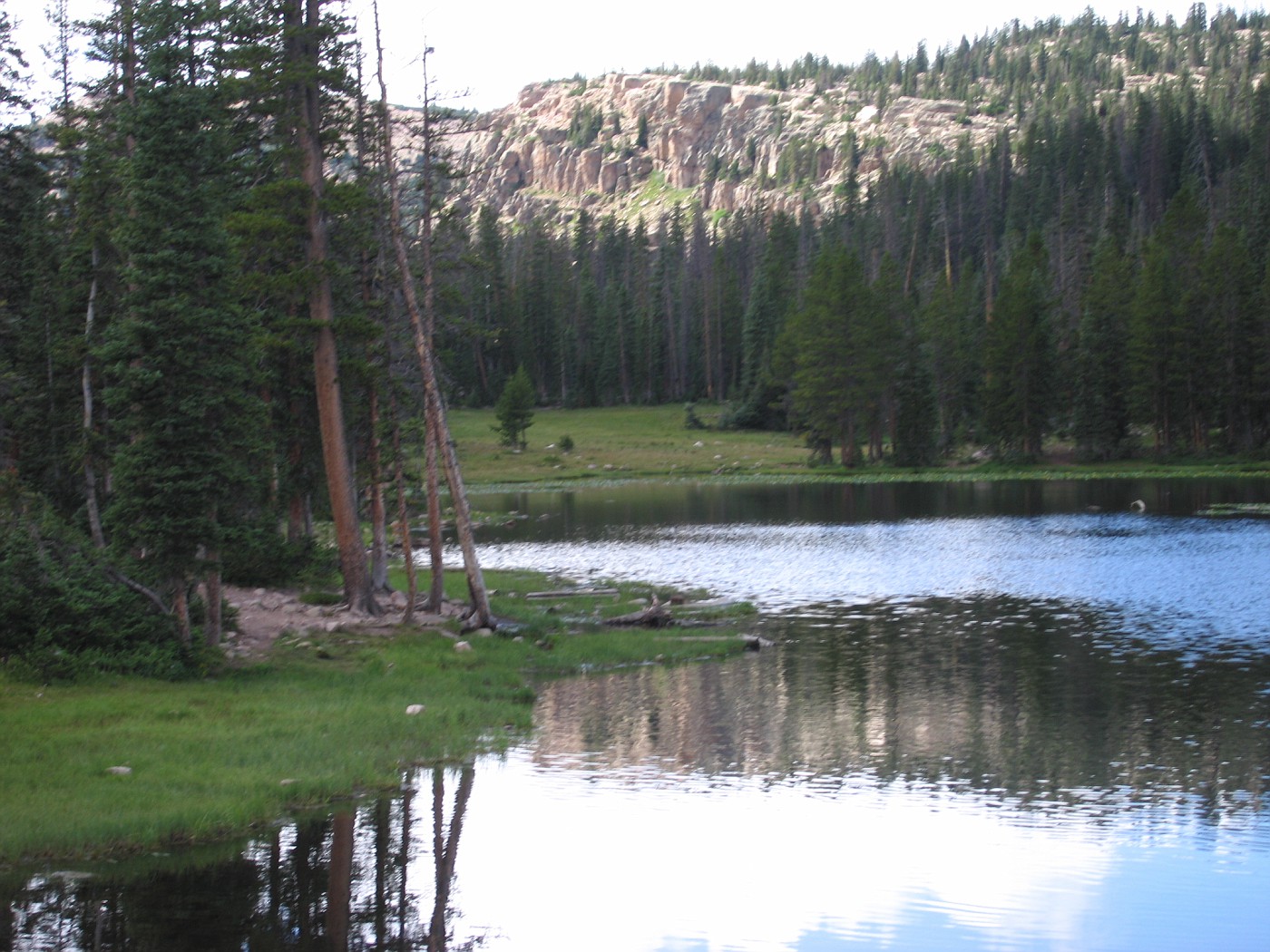
*The above picture was taken at 9,000 or 10,000 feet in the Wasatch Mountains, east of Salt Lake City, Utah. It's worth the visit.

Monday, November 27, 2006

More on the Sandstone Bench

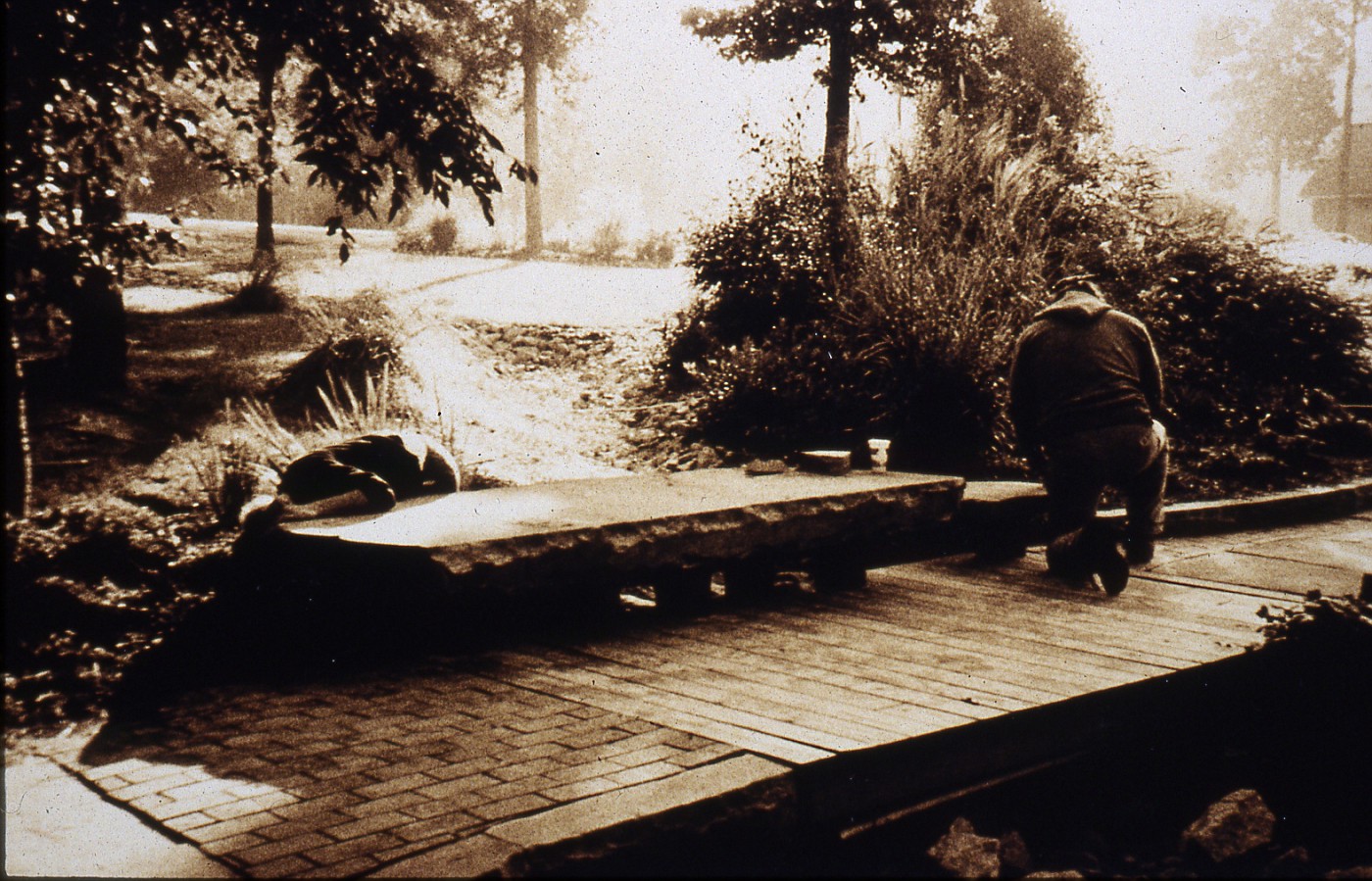
From the yard, a look before final facing
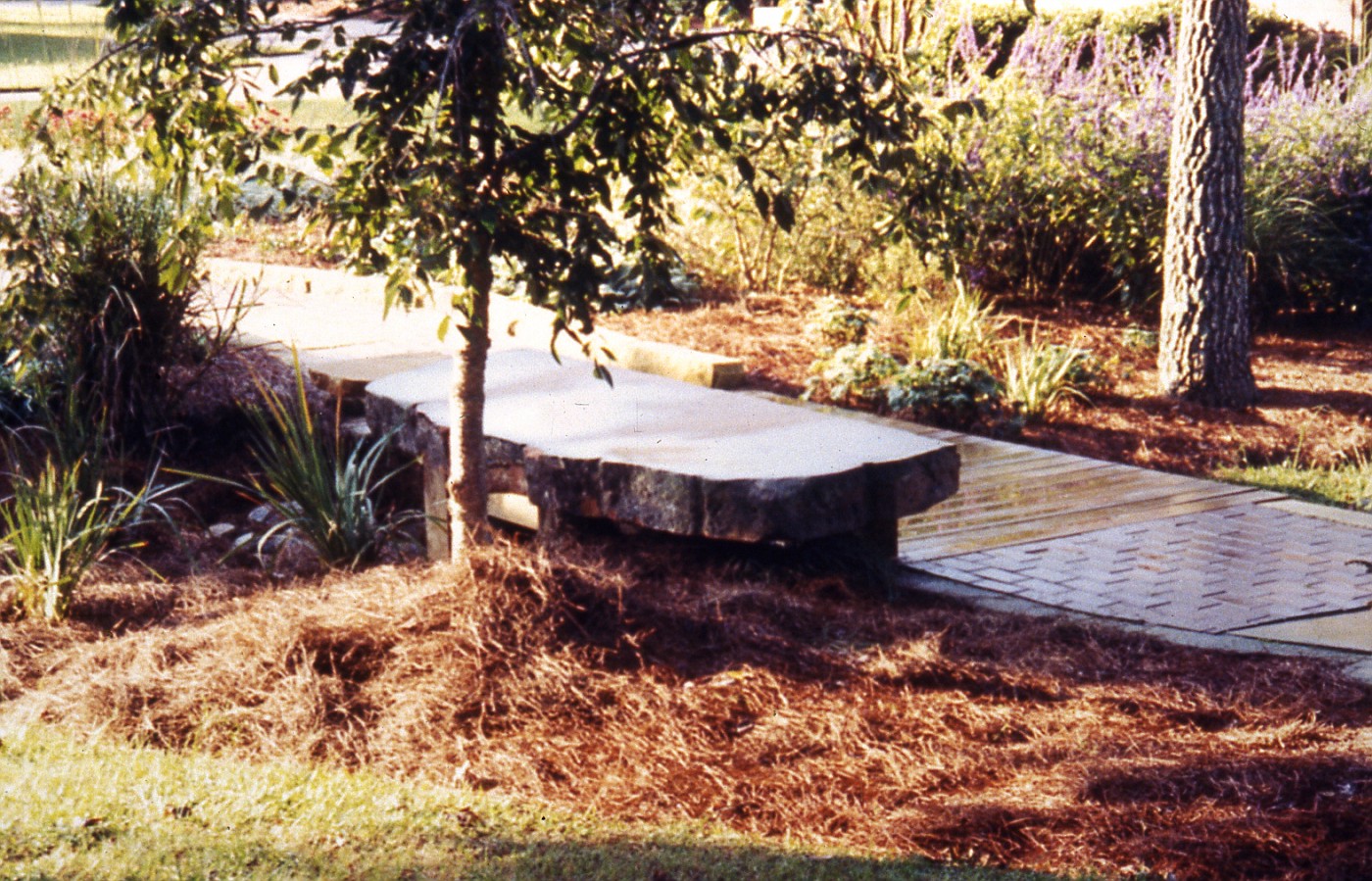
Comments, e-mails, even a phone call. Thought I would show a few more shots of this rather large bench. You can see part of the walkway, a combination of pavers, sandstone slabs, and wood for the bridge.

A look from top of walkway:
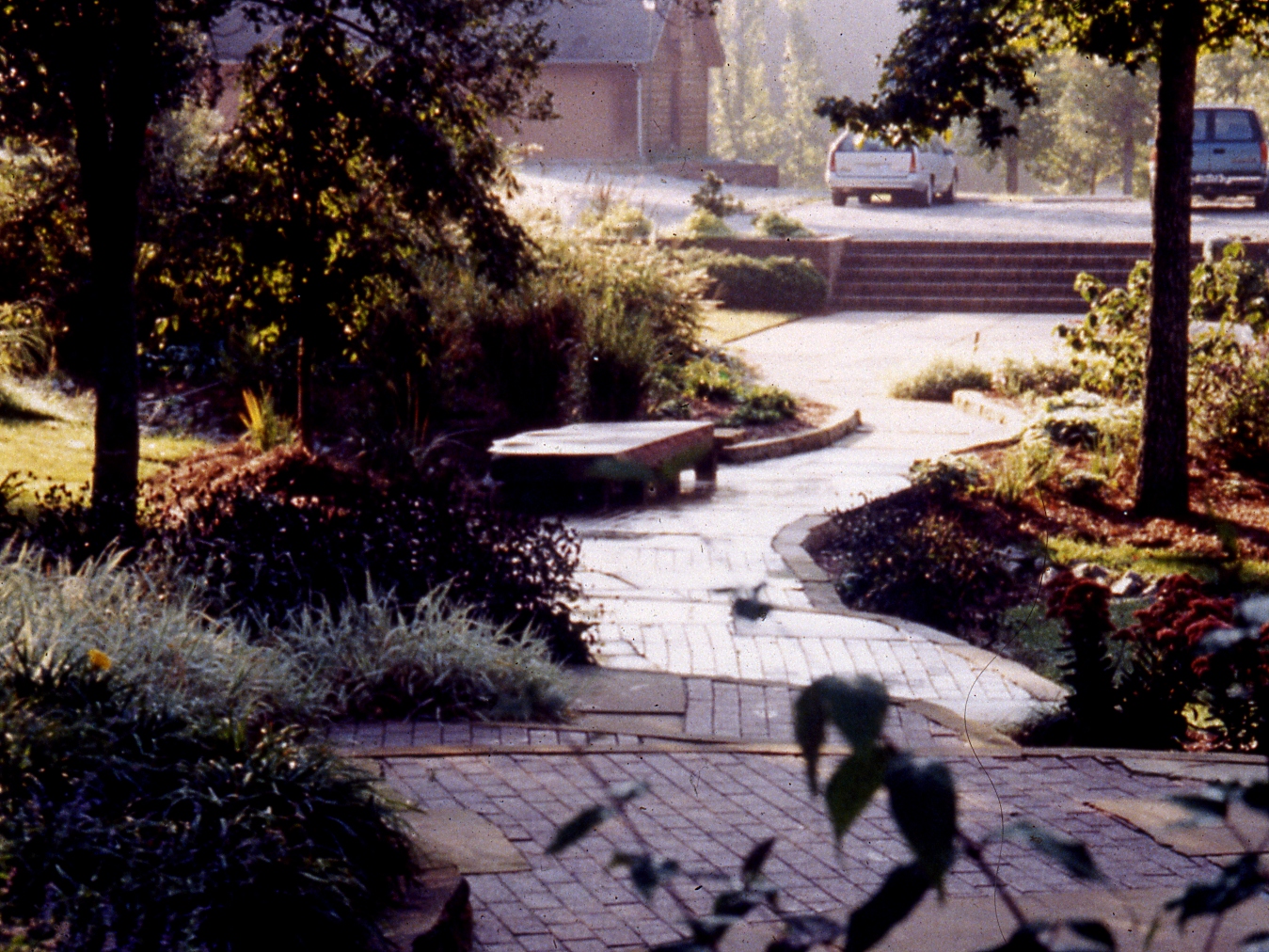
This is a look of the project/walkway in the fall, you can see down to the bench on the left. I was asked to create a pleasant walkway from the front of the house to the pool house.

The client was very adamant in her desire that the walk would be interesting, and those visitors getting out of their vehicles would be able to look over to a very pleasant scene.

The walkway is over 120 ft. long, and the width varies from 5 to 8 feet. All the rules for walkways were thrown out, rules for steps were thrown out, pretty much all rules were thrown out. In the end it was all about the aesthetic, the visual, the experience.

Sunday, November 26, 2006

An Appreciation of Stone 18

A Sandstone Bench
This sandstone slab is just over 9.0 wide and about 3.5 feet deep. We used a tractor with extended forks to set this slab. After it was set I did some facing on the stone to create that interesting edge.

The slab came from the discard pile at Briar Hill Quarries, which is located in nowhere, Ohio. It is truly out in the country very close to Glenmount, Ohio. The folks at Briar Hill are good people. If you call and get Rusty tell him Rick Anderson said hello.

Saturday, November 25, 2006

A link kind of day

Some old Doodle:
A interesting article from Southern California about ripping out the yard and filling it full of plants.

Katie Campbell has written a book called Icons of Twentieth-Century Landscape Design, here's an excerpt:
In her book, Icons of Twentieth-Century Landscape Design, Campbell explores 29 sites, from Parc Guell, Gaudi's Art Nouveau extravaganza in Barcelona, to the stark landscape around the Jewish Museum in Berlin; and two Scottish gardens have made their mark on the international design scene.
This article goes into the thought process behind the book and what Ms. Campbell is hoping to accomplish, I look forward to reading this one.

Do you like maps? Do you know how to read a map? Some folks consider large landscape plan drawings-maps. Well I like maps and heck I can even read a complicated landscape plan. Here's a Blog that looks at the World of maps, strange maps to be exact.

Friday, November 24, 2006

Tree selection (follow-up)

I found another article on the trees for the WTC memorial. This article goes into a rather detailed explanation of the trees, selection, holding area, planting, and culture involved to make this work.
A interesting read.

Wednesday, November 22, 2006

World Trade Center Memorial (tree selection)

From a article in the NY Times:

"This is the field where 380 swamp white oaks and 57 sweetgums — to be shipped in from nearby states — will be kept and cultivated before making one more journey in 2009, to the World Trade Center memorial in Lower Manhattan".

Swamp white Oaks in new York City, I find that very interesting. Now I am sure people much smarter than me have made this decision, and know what they are doing, but swamp white oaks?

I just have a hard time wrapping my head around this one. To me the cultural requirements just seem so opposite. It will be interesting to see how the prepare the for the planting holes and how much room they allow for root growth, water, oxygen, etc.

Again they are much smarter than me, so I am sure they have this worked out.

By the way this is Quercus bicolor from Michael Dirr's description:

  • Found in low-lying swampy situations.
  • moist bottomlands, along streams.
  • requires acid soil.
  • mixed news on transplanting ease.
  • normal color is yellow, he says he's seen red-purple.
  • Natl. champion is 120' x92' in Maryland.
It's closely related to Quercus alba which is a good-looking tree, one of my favorite oaks, but I understand a very difficult tree to transplant.

I wish all the best for the landscape design for this project, if any memorial was deserving of a contemplative place the World Trade Center is certainly deserving

In regards to the sweetgums, they are a beautiful tree, great fall color, good presence (straight trunks and all).

Tuesday, November 21, 2006

Books for the Laymen

Several weeks ago I posted a list of 27 books I thought were good books for the Professional Landscape Designer. I see that Joel Lerner has written a suggested book list for the home gardener.

If Joel suggest this list I am sure it is a good one. I've known Joel since 1989 and have a lot of respect for Joel and his wife Sandy, they are really good people and fun to work with. Joel is also the consummate professional, and well thought of in our industry. Joel also has several books to his credit.

Beyond that he was one of the movers and shakers who had a lot to do with the formation of APLD. APLD is the only professional organization that speaks as the international voice of Professional Landscape Designers.

Having said all that I am sure it's a good list.

Another top 10 list (that's a joke)

Ta-da! 10 tips for creating a beautiful landscape. Come on down you've won! Quick, neat, easy, no muss-no fuss. I am really tired of these list, they compete with HGTV in what annoys me the most.

The easy way out.

This kind of stuff does more to set us back than move us forward. See, what these list do is tell you the what, but in no way, no shape, no how!!! Nowhere in this list does it even begin to explain the how's . . . the real teaching that needs to be done, the real technique. Just follow this list blindly along and boom . . . . . . beautiful landscape.

So homeowners then become turned off by the whole process, the heartache, the backache! and the lost money.

We professionals then get called to solve the problems, of frustrated, angry, tired, sore, homeowners. At least these people have tried, and then realize they need professional help and call us. I actually feel bad for this group of homeowners as opposed to another type of homeowners.

The no maintenance crowd. Or the doesn't care crowd-because you/service are going to maintain. But that's for another day . . .

Desire Path ?

I have always been fascinated how; we, in the landscape industry use words. Especially how Designers use words to help describe what they are trying to design, to come up with a phrase that matches the situation or solution.

Have you ever seen a worn out path of grass in a lawn? Or a beat down path where people take a short cut? Well apparently there is a phrase for it, and it seems so simple, so perfect That i can't believe I haven't used this phrase before . . . desire path.

I know this will now become part of my toolbox of phraseology, how cool!

Monday, November 20, 2006

Does the Pergola fit the front entry?

Color rendering: markers, colored pencils on yellow trace
This rendering is another take on what we had discussed last week. Especially the talk about where does the fountain belong, or not belong.

This rendering shows the fountain a little further up the sidewalk with a pergola area further behind and to the right. Do they belong together? I'm not sure, but do Tom and Katie belong together? Not sure there but we are all giving it a shot.

It is important to remember in a conceptual that it is just that . . . . a conceptual. If you are going to critique something, or tear it apart, or move something around-now is the time. The client wanted to see if a pergola/gazebo would work, and where I would suggest it. My take is the structure belongs off to the right and back from the sidewalk.

Back to last week, I'm not any more sure about this idea than the other rendering I had up last week. I'll be real curious how the homeowners react to suggestions. I am pretty sure either solution was beyond their scope of visualization . . . this is not a bad thing or a offhand remark, it's just how these concepts work out.

When clients ask for paving, walkways, structure, classical fountains, driveways, and parking courts . . . it gets complicated. Heck, that's why I get called in.

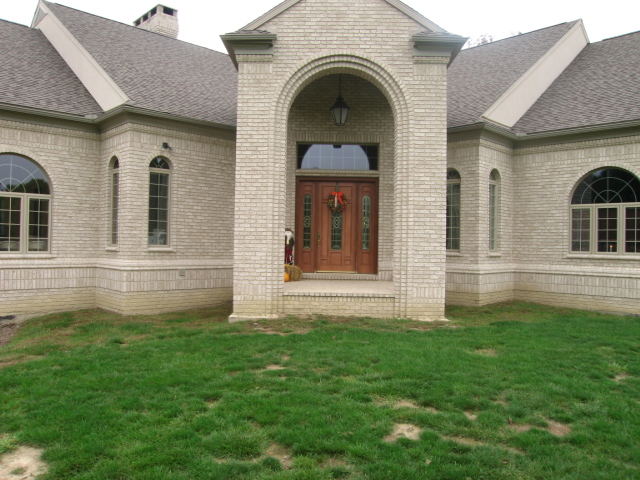
A unobstructed view of existing front door
Well here it is. The entry is big, it's massive, it's imposing and it goes absolutely, positively nowhere . . .

Sunday, November 19, 2006

An Appreciation of Stone 17

Sandstone formation in Southeastern Ohio.

Saturday, November 18, 2006

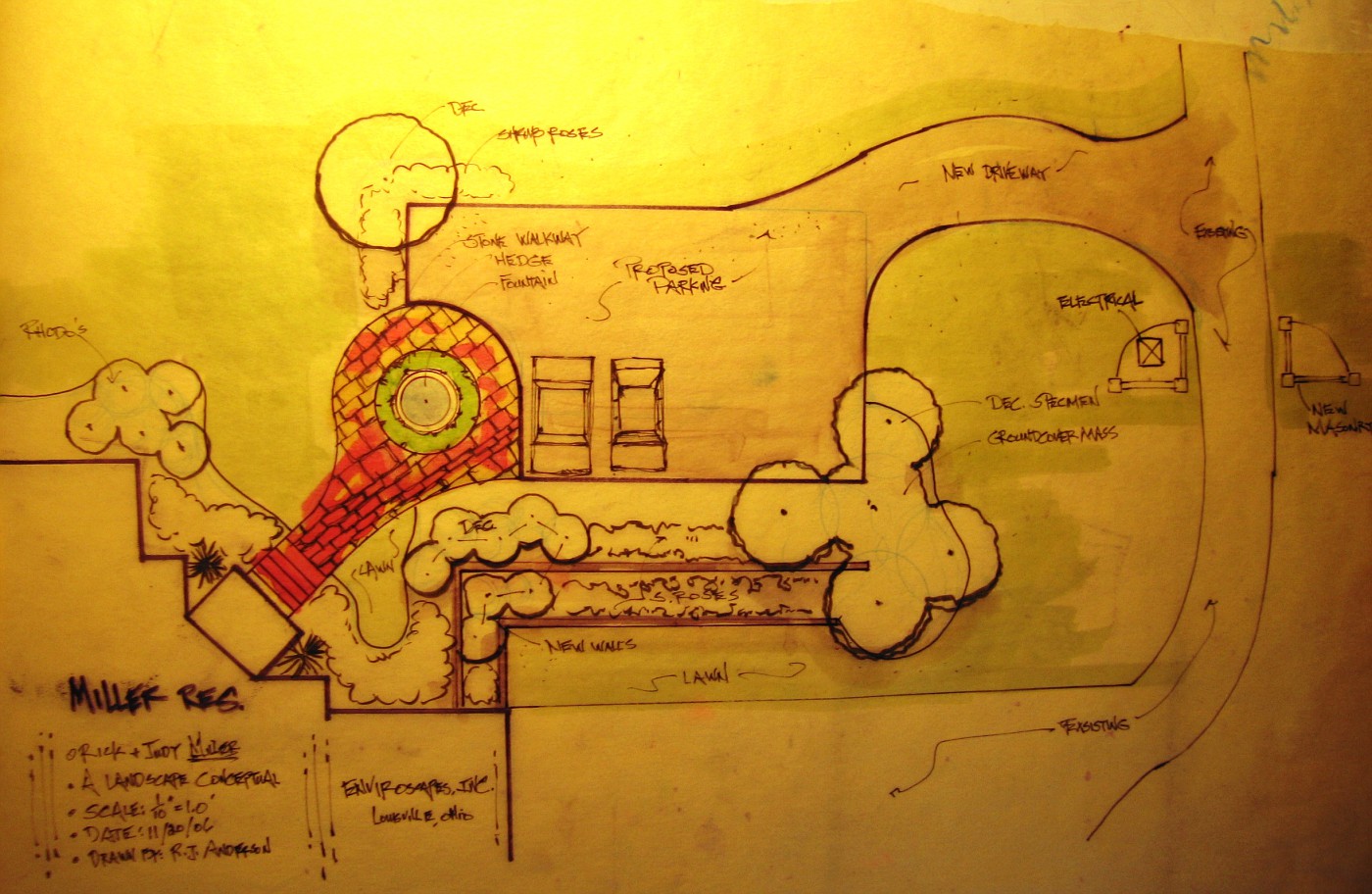
Plan View Rendering (fountain)

This drawing goes with previous renderings.
Okay all the hemming and hawing about the fountain and where it goes, what goes with it, or not with it, etc . . . . well here it is.

This is a photo that was shot off the drawing board right after I had finished this drawing. In the lower part of the drawing is the driveway for the garages, from there to the new parking court the height differential is about 8.0' foot.

Everything on the drawing would be new. There are no walls right now, no plant material of any kind, no walkway-nothing. That drive on the far right is there, the drive goes around to the horse barns, but we have to come past the utility boxes to start the new drive up to the parking court.

What does this plan view show us? A new entry drive, a parking court, a walk to the front door, a gathering place (where the fountain is), and how the beds for the plant material would/could work.

Now that I am showing this drawing does it make any more sense? Does it make any more sense to me? I am still not sure I like how this thing lays out, or the flow, but it is, what it is . . .

Thursday, November 16, 2006

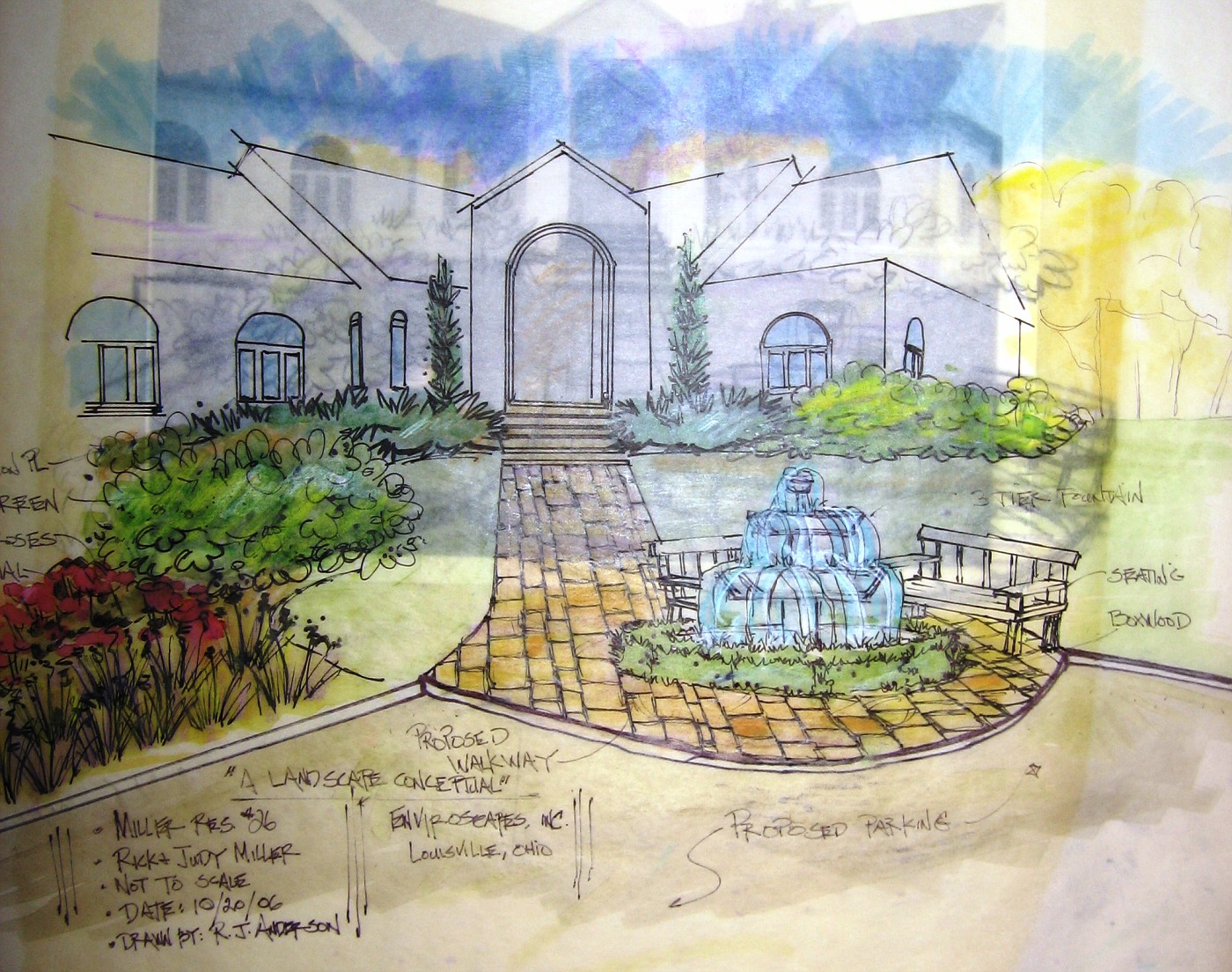
A Front Entry Fountain

A Fountain for nowhere, maybe?
This is the image I spoke of a few posts earlier. I took this right after I finished the drawing. You can see the tracing paper beneath and the original photo beneath that.

On the tracing paper is a sketch done in pencil, what I was after was a outline of the fountain and how it related to where I was guessing the end of the walkway would be-and it was a total guess.

The foreground is the parking court. I would call this an entry garden, or entry courtyard. The homeowners got themselves in a little bit of trouble here. They designed the back of the house to face the primary view (a 5 acre lake). The drive came into the side with a 3 garage door entrance, which wound up being an entire story below the main living level. And the grandiose front door??? Well here it is completely detached from the drive, the garages, the view . . . everything.

So they have lived in the house for awhile and have now realized why no one comes to the front door . . . no one can get to it!!!

So in order to get there we have to get a driveway up there, and we have to park the cars, of course, and then we have to be able to get folks from the parking court to the front door. While we are at it we might as well make the journey from the car to the door interesting. We also need to have a gathering place to say hello or goodbye.

They also need to add some plant material to transition from the house to the surrounding grounds. Right now there is nothing, zip, zada, zero! The softer perennial/grasses to the left act as a buffer zone between the parking and one of the retaining walls to be added.

Do I like the design? not sure . . . I can't decide on the fountain, it seems too exposed and it appears I have taken a very formal subject and placed it in a very informal setting. I'm just not sure it works.

As for the actual drawing . . . by now my loyal readers know I am never satisfied with those drawings, need to keep working on those.

Wednesday, November 15, 2006

Ice-Cream Monster Toon Cafe

I am not sure how Alina came up with this name for her Blog, but hey it works for her which is all that matters.

Another great post of her fantastic ability to make a page come alive, she is so good with color. Plus this time she throws in a little philosophy. So I think I'll throw some in too.

"Farmer, pointing the way, with a radish" -Issa

Looking at the Urban Environment

A Blog that takes a unique look at the urban environment, the good and the bad, with the decay and the possibilities of all that entails.

The name: Walking Turcot Yards, it's worth a look.